Arvi Wattel
Garofalo’s paintings for San Bernardino in the collection of the Hermitage and female devotion in Renaissance Ferrara
In 1509, Duchess Lucrezia Borgia transformed the empty buildings of San Bartolo at the Via Giovecca into a female monastery for her niece Camilla, the illegitimate daughter of Cesare Borgia, who had arrived in Ferrara in 1507. In the past, scholarship on San Bernardino has largely focused on the role of Lucrezia Borgia, who remained involved after its construction: she frequently withdrew from court life to the convent for periods of prayer and retreat. However, the fame of San Bernardino not only depended on Lucrezia’s involvement. After the Duchess’ death in 1519, the convent’s reputation continued to grow, in large part thanks to Camilla. Posthumous accounts praised her piety and virtue. Cherubino Ghirardacci (1519-1598) for example wrote that Camilla had lived ‘saintly’ life and underscored how she “come specchio di gloriose virtù” was revered and honoured by everyone. Flaminio da Parma (1760) praised her as “un vivo esempio” who was ‘saintly imitated’ by many. Camilla’s fame and the convent’s well repute is confirmed by the increasing numbers of nuns entering San Bernardino: in 1510 the convent started off with only twenty nuns, but within 30 years their number had grown to 107, by far extending the desired maximum of 40. It was Camilla’s sanctity, recalling the fame of sante vive like Elena Duglioli in Bologna, Osanna Andreasi in Mantua or Stefana Quinzani in Brescia, which attracted many women to the convent. Among them were not only women from Ferrara’s noble families, but as well a daughter of Pandolfo Malatesta, Lord of Rimini, and of Guidobaldo I da Montefeltro, Duke of Urbino.
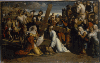
Women in clausura continuously meditated the mysteries of Christ’s Passion. In San Bernardino, these meditations must have received an important impulse with the arrival of two relics, donated by Chiara da Montefeltro around 1520: a drop of Christ’s blood and a piece of the wood of the Cross. The paintings the artist Garofalo conceived for the Poor Clares, painted probably between 1528 and 1537, helped the nuns in their meditations as well. Garofalo’s paintings for the chiesa interna (which included the Road to Calvary from the Hermitage) centred on Christ’s Life and his Passion. The small cycle of five canvases culminated in the large lunette depicting Christ crucified surrounded by flying angels who hold up cups to receive Christ’s blood pouring out of his wounds. The lunette probably hung above a gated window in the wall that separated the nun’s choir from the outer church. Through this window the nuns would have been able to watch the priest celebrating the Eucharist, whereby the vision of the corporeal (Christ’s body) would blend with the nun’s spiritual devotions. In this context, Garofalo’s painting(s) served as an important devotional tool.
The central place of the Eucharist is underscored in three other paintings for the convent in the collection of the Hermitage: the Marriage at Cana, the Allegory of the Old and New Testament, and the Feeding of Five Thousand. While these paintings were destined for the convent’s refectory the centrality of the Eucharist speaks for itself. However, the cycle's extensiveness underscores the importance the theme held for the nuns. Moreover, in this cycle the boundaries of reality and fiction are sought again, with the inclusion of some Poor Clares in the scene of the Feeding of Five Thousand. In Garofalo’s paintings for San Bernardino the artist time and again consciously tried to dissolve the boundaries between the stories of Christ life and the daily life of the nuns. Living in the enclosed environment of a clausura and continuously meditating the mysteries of the Passion lead very often to spirited devotion, heavenly visions, or even ecstasies. Within this context, Garofalo’s paintings must have been very effective.
Why Garofalo would have painted these paintings for San Bernardino (partly) for free, “per l’amor di Dio”, still needs further clarification. However, the fact that Girolamo Borgia, the sun of Cesare, stood as a godfather to Garofalo’s son, could be an important lead. In the left background of the Road to Calvary Garofalo depicted a nobleman looking out of the picture. Although the man until now remains unidentified, there is no doubt - compared to other figures – that this must be a contemporary portrait. Could this be the portrait of Girolamo Borgia, the brother of Camilla?