Kamilla Kalinina
The painting technique of Lorenzo Lotto through the analysis of four paintings of the State Hermitage Museum collection
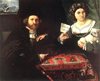
Lorenzo Lotto was one of the outstanding artists of the Italian Renaissance in the early sixteenth century. Publications, concerning the painting materials of this artist have mainly focussed on examinations of inorganic pigments. No detailed studies have been made of Lotto's binding media.
The period going from the fifteenth to the middle of the sixteenth century corresponds to a transition from the use of egg tempera to oil-based binding media in Italy. As was determined recently this process was more sophisticated than had previously been assumed. Results of paint binding media analyses of Italian paintings have shown that a transition from pure egg tempera to oil media from the 1460’s over a period of 30-40 years cannot be sustained.
This paper is devoted to study the composition of organic and inorganic media used by Lorenzo Lotto. Four paintings of Lorenzo Lotto, created in different phases of the artist's life, from The State Hermitage Museum collection were investigated: Christ Leading the Apostles to Mount Tabor (1511/1512), Family Portrait (1523/1524), Rest on the Flight into Egypt with St. Justine (1529/1530) and the recently attributed (2008) Madonna delle Grazie (1523/1524).This last painting was stored in The State Hermitage Museum for a long time and was formally listed as painting by an unknown Italian artist. All of the upper part of the painting behind the head of the Madonna was covered by a dark opaque brown-red paint applied in a past restoration. Infrared reflectography revealed three figures of angels under this conservation coating. These findings led to this painting being attributed to Lotto.
Inorganic materials were determined by means of SEM-EDX. Of note was the finding of powdered colourless glass in the priming layer of the Madonna delle Grazie, used as dryier.
Organic materials were analysed with a GC-MS analytical procedure that permits the characterisation of proteinaceous, resinous, glycerolipid and waxy material in the same micro sample, also in the presence of interfering inorganic pigments. The technique was applied to sub-samples representing, when possible, one or more paint layers, obtained by means of a scalpel under the binocular microscope. The investigation of the organic materials revealed a singular use of plant resins and egg not only in the paint layers, but also in the preparation and priming layers. Moreover, it was found that a tempera grassa made with drying oil, egg and animal glue was, in most cases, the painting technique adopted for the coloured layers.