Alexander Kruglov
Catalogue of the Hellenistic Sculpture in the Hermitage collection
The collection of the Hellenistic sculpture in the Hermitage Museum does not reveal a homogeneity, and the future catalogue will be presented in two volumes: the first volume will include the Greek originals, the second volume will deal with the Roman copies and variations which give the idea of groups and one-figure compositions, of major types in the Hellenistic sculpture.
Working on the catalogue means also a research on the history of collection. The main part of the original works of the Hellenistic sculpture in the Hermitage Museum appeared thanks to the archaeological excavations on the Northern Black Sea littoral during the 19th-20th centuries, while most of the Roman copies have their provenance from different private collections and originated from Italy in the course of the 18th-19th centuries. Of great importance is the task of tracing in the archaeological provenance and the historic context of the pieces which have been acquired in Italy.
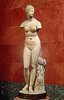
My study during my time in Ferrara was dedicated to investigation the practices of the archaeological digs and the collecting of Classical antiquites in Rome in the 18th century and the cases of finding the pieces of the Hellenistic sculpture in Rome. This is of particular importance, especially when meaning such a famous statue, the so-called Venus of Tauris, dated to the second half of the 2nd century B.C. The next step in her study would be connected with the following questions such as who the owner might have been and when the statue was brought to ancient Rome, thus determining where the statue was located. Naturally the information on the location of the find of the statue in the 18th century Rome could be correlated with the topography of ancient Rome and bring to light the history of her presence in ancient Rome, but the information of this kind is completely lacked. That is why the research took shape in the assumption based on the historical plausibility. The association with Julius Ceasar as a probable owner of the Hellenistic statue of a naked goddess is pure speculation, but in fact presents a strong case.
The research was conducted using the facilities of the libraries of the City of Ferrara and the University of Ferrara, the library of the Univesity of Padua, and mainly the library of l’École Française de Rome. The practical issue of the research was resulted with my paper entitled “Hellenistic Sculpture in Rome: the Case for the Venus of Tauris” and presented at the XVIIth International Classical Congress in Rome in September 2008.